JOHN DEERE VAN BRUNT 1910-1930S Grain Drill
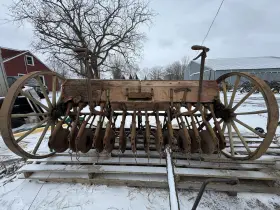
( Brand: John Deere Van Brunt ), ( Manufacturer Part Number: 1910-1930S ), ( Part Type: Drill ), ( Compatible Equipment Make: John Deere ), ( Compatible Equipment Type: Grain Drill, Seed Drill )
Review JOHN DEERE VAN BRUNT Vintage Grain Drill
The Deere & Company Van Brunt Grain Drill, manufactured between 1910 and the 1930s, is an iconic piece of agricultural equipment from the early 20th century. This drill, named after its inventor, L.B. Van Brunt, was a significant advancement in seeding technology during that era.
The Van Brunt Grain Drill is a combination seed drill and cultivator, designed to sow seeds and simultaneously cultivate the soil to ensure optimal germination and growth. It features a unique design with a series of seed boxes mounted on a rotating drum. Each seed box contains adjustable openings, allowing farmers to control the depth and spacing of the seeds as they are dropped into the ground.
The drill's drum is driven by a tractor's power take-off (PTO) shaft, which provides the rotational force necessary to turn the drum and distribute the seeds evenly in the soil. The seed boxes are arranged in a staggered pattern around the drum, ensuring that seeds are planted at consistent depths and spacings, even in uneven terrain.
The Van Brunt Grain Drill also includes a cultivator attachment, which is engaged as the drill passes over the soil. This cultivator consists of a series of interchangeable tines that loosen and aerate the soil, allowing the seeds to make better contact with the ground and access water and nutrients more easily.
Additionally, the drill's seed boxes can be filled with a variety of seed types, making it a versatile tool for farmers who grow multiple crops. The drill's robust construction, with heavy-duty components and durable materials, ensures its longevity and reliability, even in challenging farming conditions.
When in use, the Van Brunt Grain Drill offers several advantages over traditional seeding methods. Its ability to sow seeds and cultivate the soil in one pass saves time and reduces the need for additional passes with separate cultivating equipment. This not only increases efficiency but also helps to minimize soil compaction, which is crucial for maintaining soil health and productivity.
In summary, the Deere & Company Van Brunt Grain Drill is an essential piece of agricultural equipment from the early 1900s. Its innovative design, which combines seeding and cultivating in one pass, makes it an invaluable tool for farmers during this period and a testament to the ingenuity and progress of agricultural technology.
A Retrospective Analysis of the Deere & Company Van Brunt Grain Drill (1910-1930s)
Introduction:This analysis aims to provide an informative retrospective on the Deere & Company Van Brunt grain drill, which was widely used from the 1910s to the 1930s. The following sections present the pros and cons of owning and operating this historical farming implement.
Pros:1. Reliability: The Van Brunt grain drills were renowned for their durability and reliability. They were constructed using high-quality materials, ensuring they could withstand the rigors of intensive farming.
2. Versatility: The Van Brunt grain drill could be used for both small and large-scale farming operations. It was capable of drilling and planting various types of grains, such as corn, wheat, and oats, making it a versatile investment for farmers.
3. Time-saving: The Van Brunt grain drill allowed farmers to plant and sow their fields more efficiently than traditional methods. It could seed and cover the ground in one go, saving valuable time and labor.
4. Soil Conservation: The Van Brunt grain drill promoted soil conservation by minimizing soil disturbance. It placed the seed directly into the soil, reducing the need for extensive tilling and plowing.
5. Cost-effective: The Van Brunt grain drill was an affordable investment for farmers during the 1910s to the 1930s. Its longevity and efficiency made it a cost-effective solution for farmers looking to improve their farming operations.
Cons:1. Limited Capacity: The Van Brunt grain drill had limited capacity compared to modern grain drills. It required frequent refilling, which could slow down the planting process for larger farms.
2. Maintenance: While the Van Brunt grain drill was durable, it required regular maintenance to keep it in optimal condition. This included cleaning, lubricating, and repairing worn-out parts.
3. Manpower Intensive: Operating the Van Brunt grain drill required a significant amount of manpower. It needed a team of workers to load the drill, operate it, and clear obstacles from the field.
4. Limited Adaptability: The Van Brunt grain drill was not well-suited for uneven terrain or rocky fields. Its design made it less adaptable to challenging farming conditions.
5. Limited Speed: The Van Brunt grain drill was slower than modern farming equipment. Its speed limited the amount of land that could be covered in a day, making it less efficient for large-scale farming operations.
Conclusion:The Deere & Company Van Brunt grain drill was an essential farming implement during the 1910s to the 1930s. Its reliability, versatility, time-saving capabilities, and cost-effectiveness made it an invaluable investment for farmers during that era. However, its limited capacity, maintenance requirements, manpower intensity, limited adaptability, and slow speed were significant drawbacks.
Recommendation:For farmers operating modern farming operations, purchasing a Van Brunt grain drill may not be the most practical choice due to the significant differences in technology and efficiency. However, if you have an interest in historical farming equipment or are restoring a vintage farm, the Van Brunt grain drill is an excellent addition to your collection. It provides a unique insight into the farming methods and technology of the past. If you are looking for an efficient and modern grain drill, consider investing in a newer model designed to meet the demands of contemporary farming operations.
Details:
For Sale: Vintage 1910-1930S John Deere Van Brunt Grain Drill, Features a single wood en seed box with original and branding. Message for inquiries.
part #: 1910-1930s prices
- $675.00-$1144.00
specifications vintaequip:
- brand: John Deere Van Brunt
- mpn: 1910-1930s
- part type: Drill
- compatible equipment make: John Deere
- compatible equipment type: Grain Drill, Seed Drill
seller vintaequip:
- city: Foley, Minnesota
- # reviews: 7
- rating: 100.0%
offer vintaequip:
- best offers: True
- quantity: 1
- sold: 0
- options: Seller-arranged-local-pickup
- started: March 5, 2025
- availability: In Stock
shipping vintaequip:
general vintaequip:
- Heavy Equipment, Parts Attachments > Heavy Equipment Parts Accessories > Antique Vintage Equipment Parts
- condition: Used
returns vintaequip:
- policy: Returns Accepted
- paid by: Buyer
- method: Money back
- time: 30 Days
payments vintaequip:
- wallet: Paypal
- other
- credit card: Diners-club
John Deere Van Brunt 1910-1930S Is Similar To:
- John Deere Dltx3 Antique Schebler Carburetor Brass Parts Tractor 2 Cylinder (38.1% similar) Brass housing. Both butterflies turn. DLX 3 the nut that holds the bowl on looks to have been soldered or Job welded at one point and time. See pictures for the absolute best. Selling for parts or total rebuild...(May 15th, 2024)
- John Deere A3637r A Cylinder Arm Transport Bracket (35.6% similar) Part #: John Deere A3637R for sale...(May 17th, 2024)
- John Deere Af1097r G Clutch Housing F915r Antique Tractor New Old Stock (36.1% similar) Part #: John Deere AF1097R for sale...(May 17th, 2024)
- Vintage John Deere Parts A4347r Generator Mounting Bracket For 50 60 Antique Tractor (37% similar) Part #: vintage John Deere parts A4347R for sale...(May 17th, 2024)
- John Deere Ab2758r Styled B Tractor Clutch Driver B1849r Great Shape (33.6% similar) No cracks and splines look great...(May 18th, 2024)
- John Deere Ab3844r Genuine Used Late B 50 Tractor Flywheel B2461r (34.5% similar) Part #: John Deere AB3844R for sale...(May 20th, 2024)
- John Deere B1952r B Flywheel Antique Tractor (46.3% similar) Part #: John Deere B1952R for sale...(May 20th, 2024)
- John Deere R73527 450 Flywheel Housing (36% similar) Part #: John Deere R73527 for sale...(May 20th, 2024)
- John Deere D12-10b5-05jd Actuator 0298 (44.9% similar) Removed in working condition from my 2008 John Deere 6X4 gator...(May 21st, 2024)
- John Deere 5547r Rock Shaft Lift Arm a5547r (42.1% similar) P/n A5547R, fits: 520, 530 620, 630, A5547R...(May 22nd, 2024)
- John Deere H221r H Original Rear Wheel Clamp Part (35.6% similar) One of a used John Deere tractor rear wheel clamp. Removed from a model. Part number: H221R...(May 22nd, 2024)
